Thursday, 20 October 2016

Factors influencing the type of food in Spain


Geographical position.
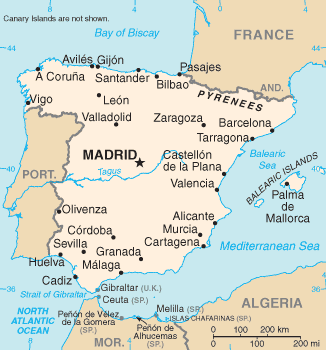
Spain is part of the Iberian Peninsula and  is bordered by Portugal and France. It has miles of coastline (more than any other European country) and seafood is a major part of the Spanish diet.

Spain is also a close to Africa. Morocco is only eight miles (thirteen kilometres)—across the Strait of Gibraltar from the southern tip of Spain. And African influences are found in the Spanish diet.

The rest of Spain is made up of go pastures and mountain ranges. The land in the interior of Spain is fertile with a  rich soil and they grow a variety of fresh vegetables, In the mountainsides there is good grazing for sheep and cattle.

Climate
The country has a dry climate and has good growing conditions for grapes and olives.

Invasions
Over the centuries Spain has been invaded on several occasions by the Greeks, Romans, Celts and Moors from Africa. This is evident in Spain's cuisine. Olives, olive oil, and wine tie it closely to Greek and Roman (Italian) culture. Meat and fish pies show the Celtic heritage. The Moorish influence is seen in the use of honey, almonds, citrus fruits, rice and spices such as cinnamon, nutmeg and saffron.


https://upload.wikimedia.org/wikipedia/commons/2/25/Saffron-IMG_6640-2.jpg


Spain explored the world
Spain was a country that was a leader in exploration. The Spanish were among the first to discover the New World (America). From the 1400s, explorers returned from voyages across the Atlantic 
Ocean with exotic new foods such as tomatoes, potatoes, sweet potatoes, beans, corn, peppers, chocolate, and vanilla (all native to the Americans). These foods became part of the Spanish diet.


https://c1.staticflickr.com/3/2695/4263402042_36e6512f54.jpg

The Background of Spain


Spain is one of the largest countries of Western Europe. It is part of the Iberian Peninsula, and stretches from the Pyrenees Mountains to the Strait of Gibraltar, which separates Spain from Africa. To the east lies the Mediterranean Sea, including Spain's Balearic Islands.

https://upload.wikimedia.org/wikipedia/commons/1/10/Sp-map.png


Government and economy
In Spain, there is a monarchy and the king and the elected president share the power. Spain is divided into 17 regions,the regions manage its own schools, hospitals, and other public services.

One of the main industries in Spain is tourism. Spain attracts more tourists than any other European country except France.

Other important industries are textiles and clothing, food and beverages, metals, chemicals, shipbuilding, automobiles, machine tools, clay products, footwear, pharmaceuticals and medical equipment.


Flag

FAST FACTS
Official Name: Kingdom of Spain
Spanish Name: España.
Capital: Madrid
Population: 47,737,941
Official languages: Castilian Spanish, Basque, Catalan, and Galician
Currency: Euro
Area: 195,363 square miles (505,988 square kilometers)
Major mountain ranges: Pyrenees, Sierra de Guadarrama, Sierra de Gredos, Sierra Nevada
Major rivers: Guadalquivir, Ebro, Duero, Miño, Tajo, and Guadiana
Sport: Football (soccer) is the most popular sport in Spain.


Geography and climate
The interior of Spain is a high, dry plateau surrounded and crisscrossed by mountain ranges. Rivers run to the coasts, creating good farmland. A large part of the interior of the country has semiarid climate, with temperatures that range from extremely cold in the winter to scorching hot in the summer. Droughts are common.  

Plants and trees grow so well on the northwestern coast, in Galicia and along the Bay of Biscay, that the area is called Green Spain. Rain, trapped by the mountains farther inland, is frequent. Beech and oak trees flourish here. Numerous coves and inlets break up the coastline.

The southern and eastern coasts of Spain, from the fertile Andalusian plain up to the Pyrenees, are often swept by warm winds called sirocco winds. These winds originate in northern Africa and keep temperatures along the Mediterranean coast milder than the interior.


Agriculture
Spain has about 50.5 million hectares of land but only 20.6 million, or about 40%, are suitable for cultivation. Even where there is cultivation the soil is generally of poor quality, and only about 10% of the land can be considered excellent.

In the north and northwest of the country there is a relatively mild, humid climate and the land is irrigated by rainfall. These are the principal corn producing and cattle-raising areas. Apples and pears were the main orchard crops in these area, and potatoes were also grown.

But large parts of the country are dry and irrigation systems are needed and those areas that have good irrigation syetems (only about 17% of the land) produce lots of fruit and vegetables for the home market and for export. Where the land has been irrigated the crops grown include corn, fruit trees, and vegetables. Agricultural products that have been helped by  irrigation include grapes, cotton, sugar beets, potatoes, legumes, olive trees, strawberries, tomatoes, and fodder grasses.

In the 1980’ s agriculture mainly involved the growing of fruit, vegetables, cereals and olives. Citrus fruits and vegetables were Spain’s main export as the growing conditions were ideal. But as the country became wealthy meat and poultry became popular in farming and became more important agriculturally than fruit and vegetables.


Friday, 14 October 2016

Hi,
my name is Emer and this is my blog on the geography of Spanish food and Spanish culture . I love going on holidays to Spain and my favourite part of the holiday is the food. I hope you can learn something new from this blog.
 I will research and explain; the background of Spain,the factors influencing the type of foods in Spain, the regional cuisine, the foods customs and cultures and will also set out a three course menu on Traditional Spanish cuisine.
Thanks for reading,


Bye